
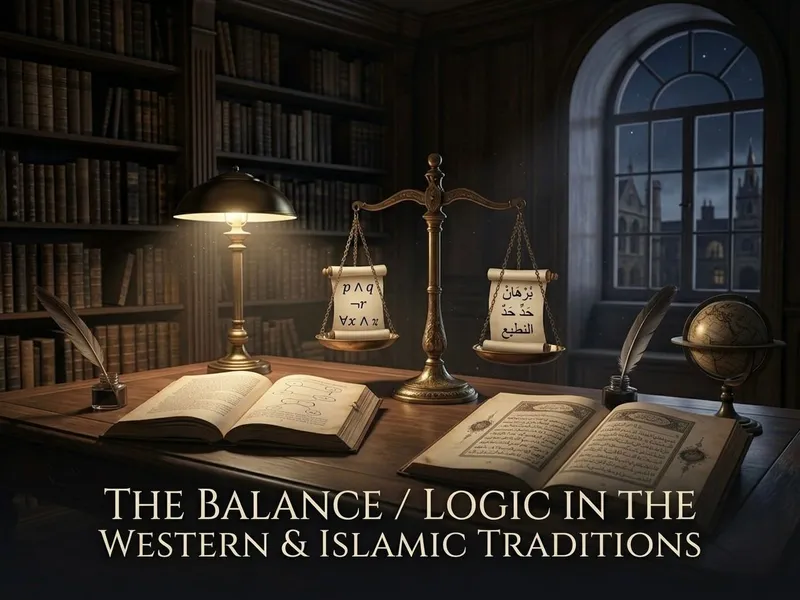
The Balance: Logic in the Western & Islamic Traditions
A one-year online course with Ustadh Reece Byfield in formal logic, analytic philosophy, and Islamic mantiq. Learn to define, formalise, audit, and judge arguments with precision.
- David Papineau, Philosophical Devices
- Patrick Hurley, A Concise Introduction to Logic
- Athīr al-Dīn al-Abharī, Isāghūjī
- Al-Akhḍarī, Al-Sullam al-Munawraq
- Theodore Sider, Logic for Philosophy
Ustadh Reece Byfield
BA Philosophy (First Class), King's College London. MPhil Theology, Religion and Philosophy of Religion, University of Cambridge. Studying 'Alimiyyah at al-Salam Institute under Shaykh Akram Nadwi. Holds ijazat in various texts.
Syllabus
Month 1 Sets, Numbers & Argument Structure (Q1: Philosophical Infrastructure)
Build the mathematical and semantic floor required for analytic philosophy and disciplined argument analysis.
Sets, Numbers & Argument Structure (Q1: Philosophical Infrastructure)
Build the mathematical and semantic floor required for analytic philosophy and disciplined argument analysis.
- Sets and numbers
- Naive set theory
- Russell's Paradox
- Infinity
- Identifying premises, conclusions, and the structure of an argument
Month 2 Truth, Knowledge & First Concepts
Distinguish kinds of truth and kinds of knowledge, and connect them to early taṣawwur (concept) and taṣdīq (judgement).
Truth, Knowledge & First Concepts
Distinguish kinds of truth and kinds of knowledge, and connect them to early taṣawwur (concept) and taṣdīq (judgement).
- Analytic and synthetic truths
- A priori and a posteriori knowledge
- Concept (taṣawwur) versus judgement (taṣdīq) — the first comparison
Month 3 Possible Worlds, Necessity & Naming
Modal vocabulary, identity, and reference — the bridge from semantics to modal logic and theology.
Possible Worlds, Necessity & Naming
Modal vocabulary, identity, and reference — the bridge from semantics to modal logic and theology.
- Necessity and contingency
- Possible worlds
- Naming and reference
- Rigid designators
- Identity and essence
Month 4 Dalālah & the Opening of Isāghūjī (Q2: Foundation of Concepts)
How words signify meanings, and the opening structure of the Isāghūjī read in translation with instructor support.
Dalālah & the Opening of Isāghūjī (Q2: Foundation of Concepts)
How words signify meanings, and the opening structure of the Isāghūjī read in translation with instructor support.
- Dalālah: signification
- Simple and compound vocables (expressions)
- Opening structure of al-Abharī's Isāghūjī
Month 5 The Five Universals
The conceptual scaffolding of definition: how universals divide and combine to make essences and accidents.
The Five Universals
The conceptual scaffolding of definition: how universals divide and combine to make essences and accidents.
- Genus and species
- Difference (faṣl)
- Property (khāṣṣa) and accident (ʿaraḍ)
- How the universals relate to definition
Month 6 Ḥadd, Rasm & the Audit of Definitions
Essential and descriptive definitions; how to spot a defective, circular, broad, narrow, or ambiguous definition.
Ḥadd, Rasm & the Audit of Definitions
Essential and descriptive definitions; how to spot a defective, circular, broad, narrow, or ambiguous definition.
- Ḥadd: essential definition
- Rasm: descriptive definition
- Defective, circular, broad, narrow, and equivocal definitions
- Worked audits of contemporary definitions
Month 7 Sentential Logic & Natural Deduction (Q3: Formal Systems)
Truth-functional connectives, truth tables, and the formal structure of proof in sentential logic.
Sentential Logic & Natural Deduction (Q3: Formal Systems)
Truth-functional connectives, truth tables, and the formal structure of proof in sentential logic.
- Truth tables
- Sentential calculus and connectives
- Natural deduction
- Rules of inference and rules of replacement
Month 8 Predicate Logic, Quantifiers & Identity
Move beyond sentential calculus into the logic of objects, properties, and relations.
Predicate Logic, Quantifiers & Identity
Move beyond sentential calculus into the logic of objects, properties, and relations.
- Predicate logic and quantifiers
- Variables and relations
- Identity
- Translating English into predicate logic
Month 9 Models, Soundness & Completeness
Introductory metalogic — how a logical system is shown to be consistent, sound, complete, and provable.
Models, Soundness & Completeness
Introductory metalogic — how a logical system is shown to be consistent, sound, complete, and provable.
- Syntax and semantics
- Validity and soundness
- Consistency
- Completeness and provability
Month 10 Syllogistics & Conditional Propositions (Q4: Synthesis)
Categorical syllogisms, the four figures, and the logic of conditional propositions.
Syllogistics & Conditional Propositions (Q4: Synthesis)
Categorical syllogisms, the four figures, and the logic of conditional propositions.
- Categorical propositions
- Syllogistic reasoning and the four figures
- Conditional propositions
Month 11 The Five Arts: Burhān, Jadal, Khaṭābah, Shi'r & Safsaṭah
How the same form of argument can be demonstrative, dialectical, rhetorical, poetic, or sophistical depending on its premises.
The Five Arts: Burhān, Jadal, Khaṭābah, Shi'r & Safsaṭah
How the same form of argument can be demonstrative, dialectical, rhetorical, poetic, or sophistical depending on its premises.
- Burhān: demonstration
- Jadal: dialectic
- Khaṭābah: rhetoric
- Shi'r: poetics
- Safsaṭah: sophistry
Month 12 Modal Logic, Theology & Capstone
Bring formal logic and mantiq together on questions of God, essence, identity, and the soul.
Modal Logic, Theology & Capstone
Bring formal logic and mantiq together on questions of God, essence, identity, and the soul.
- Wājib, mumkin, mustaḥīl
- De re and de dicto necessity
- Modal arguments concerning God, essence, and the soul
- Ibn Taymiyya's and al-Suyūṭī's criticisms of Islamic logic
- Capstone: a single argument analysed end to end
Course Overview
Most people argue from instinct. They sense when something is wrong but cannot always say where the mistake lies — in the definition, the premise, the inference, or a hidden assumption. The Balance is designed to move students beyond instinctive argumentation into disciplined reasoning.
The course brings together two powerful traditions. Western formal and analytic logic for symbolic reasoning, proof, validity, truth tables, predicate logic, modality, and possible worlds. Islamic mantiq for conceptual discipline, definition, taṣawwur, taṣdīq, dalālah, universals, syllogistic reasoning, demonstration, dialectic, and sophistry.
The aim is not merely to study logic as an abstract subject. The aim is to learn how to think.
Learn to think with precision. Learn to define, analyse, formalise, and evaluate arguments. Learn logic through both the Western and Islamic traditions.
What You Will Study
- Papineau-style philosophical foundations — Sets, truth, necessity, possibility, possible worlds, naming, and identity
- Islamic logic / mantiq — Taṣawwur, taṣdīq, dalālah, the five universals, ḥadd, rasm, syllogisms, burhān, jadal, and sophistry
- Formal logic — Truth tables, sentential logic, predicate logic, quantifiers, proofs, validity, soundness, and model theory
- Modal and theological reasoning — Necessity, possibility, contingency, arguments for God’s existence, essence, the soul, and philosophical conflict
- Ibn Taymiyya’s and al-Suyūṭī’s criticisms of Islamic logic — The classical Muslim critique of Greek-derived logic: the arguments against definition and syllogism in Al-Radd ʿalā al-Manṭiqiyyīn and al-Suyūṭī’s abridgement, Jahd al-Qarīḥa
What Makes This Course Different
Many students encounter philosophy, kalām, uṣūl, or apologetics before they have been trained in the structure of reasoning itself. The result is often a student who knows many discussions and many arguments, yet still struggles to identify the exact logical structure underneath them.
The Balance trains students to ask:
- What exactly is being claimed?
- What do the key terms mean?
- Is the issue at the level of concept or judgement?
- Does the conclusion follow from the premises?
- Is the argument valid? Are the premises sound?
- Is the definition too broad, too narrow, circular, or ambiguous?
- Is the reasoning demonstrative, dialectical, rhetorical, or sophistical?
- Is the claim necessary, possible, impossible, or contingent?
By the end of the course, students should be able to analyse arguments with far greater precision and confidence.
Who This Course Is For
This course is ideal for students of:
- Islamic studies, kalām, and uṣūl al-fiqh
- Philosophy, theology, and comparative religion
- Daʿwah, apologetics, and argumentation
- Critical thinking and structured debate
It is also suitable for anyone who wants to reason with greater clarity, avoid common mistakes in argument, and understand both modern and classical approaches to logic.
No prior background in formal logic is required.
Language & Arabic Text Policy
This is an English-medium course. All teaching, discussion, exercises, assessments, and argument analysis are conducted in English. Arabic terms from the Islamic logical tradition are introduced as technical concepts. Students learn what terms such as taṣawwur, taṣdīq, dalālah, ḥadd, rasm, burhān, and jadal mean and how to use them in analysis. Beginner Arabic texts such as the Isāghūjī are studied with translation provided. No prior Arabic proficiency is required.
How to think about Arabic terms. Treat taṣawwur, taṣdīq, dalālah, ḥadd, rasm, burhān, jadal, and safsaṭah as technical tools. You are learning to use them in English analysis, not to pass an Arabic translation exam.
What You Will Be Able To Do by the End
- Analyse arguments with clarity and identify premises and conclusions
- Distinguish validity from soundness
- Recognise flawed definitions — circular, defective, broad, narrow, or ambiguous
- Explain the difference between taṣawwur and taṣdīq and use the core mantiq vocabulary accurately
- Understand syllogistic reasoning, the four figures, and conditional propositions
- Formalise English arguments into symbolic notation
- Use truth tables, natural deduction, and predicate logic
- Analyse necessity, possibility, impossibility, and contingency
- Evaluate philosophical and theological arguments more carefully
- Recognise when reasoning is demonstrative, dialectical, rhetorical, or sophistical
- Engage modern and classical traditions of logic with greater confidence
How the Course Works
Each month combines conceptual teaching, worked examples, technical drills, and one applied argument audit. The aim is not to read the largest number of pages — it is to build reliable habits of analysis.
Weekly drills. Short technical exercises: symbolic translations, proofs, definition audits, validity tests, syllogism checks, or modal analyses. The standard is accuracy and correction, not volume.
Monthly argument audit. Every four weeks, students take a contemporary philosophical, theological, or ideological argument and reconstruct it charitably, clarify the key terms, identify whether the issue is at the level of concept or judgement, formalise where possible, test validity, assess premises, and decide whether the argument should be accepted, rejected, repaired, or suspended pending further support.
Quarterly examinations. Practical assessments at the end of each quarter: sets and modality (Q1), dalālah and definition (Q2), formal proofs and models (Q3), syllogistics and modal analysis (Q4).
Final capstone. Students choose a philosophical, theological, or ideological argument and produce a structured analysis — defining key terms, identifying conceptual ambiguities, formalising the argument, testing validity, comparing modern formal logic with Islamic mantiq, and concluding whether the argument should be accepted, rejected, revised, or suspended.
Required & Guided Texts
Western logic and analytic philosophy
- David Papineau, Philosophical Devices — selected readings for Quarter 1
- Patrick Hurley, A Concise Introduction to Logic — sentential and predicate logic readings and exercises
- Theodore Sider, Logic for Philosophy — advanced reference for predicate logic, metalogic, and modal logic
Islamic logic
- Athīr al-Dīn al-Abharī, Isāghūjī — required beginner Islamic logic text, read in translation or dual-text format with instructor support
- Al-Akhḍarī, Al-Sullam al-Munawraq — selected translated excerpts and instructor-mediated explanation
- Al-Taftāzānī, Sharḥ al-Tahdhīb — advanced reference, used selectively by the instructor for clarification and synthesis
Students are not expected to read advanced Arabic works independently.
Frequently Asked Questions
Do I need to have studied logic before? No. The course assumes no prior background in formal logic. You are introduced to the subject step by step, beginning with foundational concepts before moving into more advanced material.
Do I need to know Arabic? No prior Arabic is required. The course is taught in English; Arabic mantiq terms are explained conceptually, and beginner texts such as the Isāghūjī are studied with translation provided.
Is this a philosophy course or a logic course? It is primarily a logic and argument-analysis course, but it includes important philosophical material because logic is needed to understand and evaluate philosophical claims. Students study tools from analytic philosophy, formal logic, Islamic mantiq, kalām, and uṣūl.
Will there be homework? Yes — regular short exercises. The aim is not to overwhelm students with excessive reading, but to build skill through repeated practice.
Is this suitable for students of Islamic studies? Yes. The course is especially useful for students of Islamic studies, kalām, uṣūl, daʿwah, apologetics, theology, and philosophy.
What if I find symbolic logic difficult? The course is designed to support beginners. Students are guided through visual mapping, worked examples, and repeated exercises. The aim is technical mastery through manageable steps.
Why This Matters
We live in an age of constant argument — religious, political, philosophical, ideological — where confidence is mistaken for proof, rhetoric for demonstration, and complexity for depth. Logic gives the student a scale. It teaches the mind how to weigh.
The Balance is designed to give students that scale.
To register your interest or ask a question, email info@akhookum.com.