Islam Foundations: The Knowledge Every Muslim Is Obliged to Know
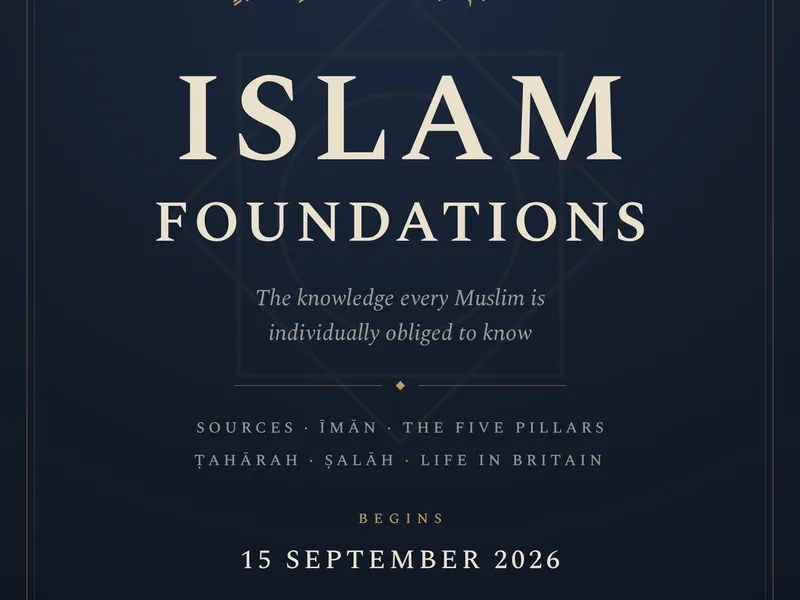
A complete 16-lesson foundations course covering the knowledge every Muslim is individually obliged to know — the sources of Islam, the pillars of īmān and Islam, purification, prayer taught properly over five lessons, and living as a Muslim in Britain today.
Ustadh Reece Byfield, Ustadh Khalil & Ustadh Malik
Taught by a team of three teachers. Ustadh Reece Byfield (MPhil Theology, University of Cambridge; BA Philosophy, First Class, King's College London; traditional studies at al-Salam Institute) leads the modules on creed, the sources of Islam, and living as a Muslim today. Ustadh Khalil and Ustadh Malik lead the fiqh modules — the pillars of Islam, purification, and prayer — with practical demonstration throughout.
Syllabus
Lesson 1 Introduction to Islam
Module 1 — with Ustadh Reece. Why we are here, what Islam is, and why this knowledge is an individual obligation.
Introduction to Islam
Module 1 — with Ustadh Reece. Why we are here, what Islam is, and why this knowledge is an individual obligation.
- Why Allah created us
- What Islam means
- The Shahādah
- Worship and servitude
- Why seeking knowledge is obligatory
- Overview of the course
Lesson 2 The Qur'an
Module 2: The Sources of Islam — with Ustadh Reece. The Book of Allah: where it came from and why it is beyond doubt.
The Qur'an
Module 2: The Sources of Islam — with Ustadh Reece. The Book of Allah: where it came from and why it is beyond doubt.
- Revelation
- Preservation
- Authority
- Structure
Lesson 3 The Sunnah
Module 2: The Sources of Islam — with Ustadh Reece. The second source of Islam and its relationship to the Qur'an.
The Sunnah
Module 2: The Sources of Islam — with Ustadh Reece. The second source of Islam and its relationship to the Qur'an.
- What the Sunnah is
- Ḥadīth
- Why we follow it
- Relationship to the Qur'an
Lesson 4 How Islam Is Understood
Module 2: The Sources of Islam — with Ustadh Reece. How scholarship turns revelation into law, and why scholars differ.
How Islam Is Understood
Module 2: The Sources of Islam — with Ustadh Reece. How scholarship turns revelation into law, and why scholars differ.
- Ijmāʿ
- Qiyās
- Madhhabs
- Sharīʿah and fiqh
- Why scholars differ
Lesson 5 Belief in Allah
Module 3: The Pillars of Īmān — with Ustadh Reece. The first and greatest article of faith.
Belief in Allah
Module 3: The Pillars of Īmān — with Ustadh Reece. The first and greatest article of faith.
- Belief in Allah
- His Names and Attributes
Lesson 6 Angels, Books and Messengers
Module 3: The Pillars of Īmān — with Ustadh Reece. The unseen order and the chain of revelation.
Angels, Books and Messengers
Module 3: The Pillars of Īmān — with Ustadh Reece. The unseen order and the chain of revelation.
- Angels
- Books
- Messengers
Lesson 7 The Last Day and Divine Decree
Module 3: The Pillars of Īmān — with Ustadh Reece. The remaining articles of faith, and what breaks it.
The Last Day and Divine Decree
Module 3: The Pillars of Īmān — with Ustadh Reece. The remaining articles of faith, and what breaks it.
- The Last Day
- Divine Decree (Qadar)
- Nullifiers of faith
Lesson 8 The Pillars of Islam
Module 4 — with the fiqh teachers. An overview of each pillar and its significance.
The Pillars of Islam
Module 4 — with the fiqh teachers. An overview of each pillar and its significance.
- Shahādah
- Ṣalāh
- Zakāh
- Ṣawm
- Ḥajj
Lesson 9 Purification (Ṭahārah)
Module 5 — with the fiqh teachers. Everything prayer depends on, with practical demonstration.
Purification (Ṭahārah)
Module 5 — with the fiqh teachers. Everything prayer depends on, with practical demonstration.
- Wuḍūʾ
- Ghusl
- Tayammum
- Impurities
- Practical demonstration
Lesson 10 Prayer I: Conditions of Prayer
Module 6: Ṣalāh — with the fiqh teachers. What must be in place before the prayer is valid.
Prayer I: Conditions of Prayer
Module 6: Ṣalāh — with the fiqh teachers. What must be in place before the prayer is valid.
- Times of prayer
- Facing the qiblah
- Covering and cleanliness
- Intention
Lesson 11 Prayer II: Pillars and Obligations
Module 6: Ṣalāh — with the fiqh teachers. The internal structure of the prayer itself.
Prayer II: Pillars and Obligations
Module 6: Ṣalāh — with the fiqh teachers. The internal structure of the prayer itself.
- Pillars of the prayer
- Obligations and sunnahs
- What invalidates the prayer
Lesson 12 Prayer III: Practical Demonstration
Module 6: Ṣalāh — with the fiqh teachers. The prayer performed step by step, and the mistakes to avoid.
Prayer III: Practical Demonstration
Module 6: Ṣalāh — with the fiqh teachers. The prayer performed step by step, and the mistakes to avoid.
- Full practical demonstration
- Common mistakes
Lesson 13 Prayer IV: Congregational Prayer
Module 6: Ṣalāh — with the fiqh teachers. Praying with others, at home and in the masjid.
Prayer IV: Congregational Prayer
Module 6: Ṣalāh — with the fiqh teachers. Praying with others, at home and in the masjid.
- Virtue and rulings of congregation
- Following the imam
- Jumuʿah
Lesson 14 Prayer V: Missed Prayers
Module 6: Ṣalāh — with the fiqh teachers. Making up what was missed, and prayer in difficult circumstances.
Prayer V: Missed Prayers
Module 6: Ṣalāh — with the fiqh teachers. Making up what was missed, and prayer in difficult circumstances.
- Missed prayers and qaḍāʾ
- Shortening and combining when travelling
- Prayer in illness and difficulty
Lesson 15 Living as a Muslim in Britain
Module 7 — with Ustadh Reece. Holding your dīn with confidence in the society you actually live in.
Living as a Muslim in Britain
Module 7 — with Ustadh Reece. Holding your dīn with confidence in the society you actually live in.
- Identity
- Family
- Work and education
- Social media
- Public life
- Daʿwah
- Contemporary challenges
Lesson 16 Continuing Your Journey
Module 8 — with Ustadh Reece. Where to go from here, and how to keep going.
Continuing Your Journey
Module 8 — with Ustadh Reece. Where to go from here, and how to keep going.
- Seeking knowledge
- Choosing teachers
- Building consistency
- Recommended next courses
- Lifelong learning
Course Overview
There is a category of knowledge in Islam that is farḍ ʿayn — an individual obligation on every Muslim, not something that can be delegated to scholars or left to others. What Islam is. Where it comes from. What we believe. How to purify ourselves and how to pray.
Islam Foundations covers exactly that, in 16 lessons across 8 modules. Nothing is assumed. Everything is taught from the beginning, with practical demonstration where it matters most.
How the Course Is Structured
The course moves in a deliberate order — each module builds on the one before it:
- Introduction to Islam (1 lesson) — why we are here and what this course will give you
- The Sources of Islam (3 lessons) — the Qur’an, the Sunnah, and how Islam is understood
- The Pillars of Īmān (3 lessons) — the six articles of faith, taught properly
- The Pillars of Islam (1 lesson) — an overview of the five pillars and their significance
- Purification (1 lesson) — wuḍūʾ, ghusl, and tayammum with practical demonstration
- Prayer (5 lessons) — the most important practical obligation after the shahādah, given the treatment it deserves
- Living as a Muslim in Britain (1 lesson) — identity, family, work, and contemporary challenges
- Continuing Your Journey (1 lesson) — where to go next and how to keep learning
Prayer is deliberately the largest module. It is performed five times every day, and no Muslim should have to guess their way through it.
Your Teachers
The course is taught by a team of three:
- Ustadh Reece Byfield — creed, the sources of Islam, and living as a Muslim today. MPhil in Theology and Philosophy of Religion, University of Cambridge; BA Philosophy (First Class), King’s College London; traditional study at al-Salam Institute.
- Ustadh Khalil and Ustadh Malik — the fiqh modules: the pillars of Islam, purification, and prayer, taught with full practical demonstration.
Who This Course Is For
- New Muslims who want a complete, structured grounding
- Muslims who grew up without formal study and want to fill the gaps properly
- Anyone returning to practice who wants to rebuild from the foundations
- Parents who want a clear reference for what their family must know
No prior knowledge is assumed. This is the starting point.
Learning Outcomes
By the end of the course, students will:
- Know what Islam teaches and where that teaching comes from
- Understand the six articles of īmān and the five pillars of Islam
- Be able to purify themselves and pray correctly, with confidence
- Know how to handle the realities of Muslim life in Britain
- Have a clear map for continuing their journey of knowledge
To register your interest or ask a question, email info@akhookum.com.