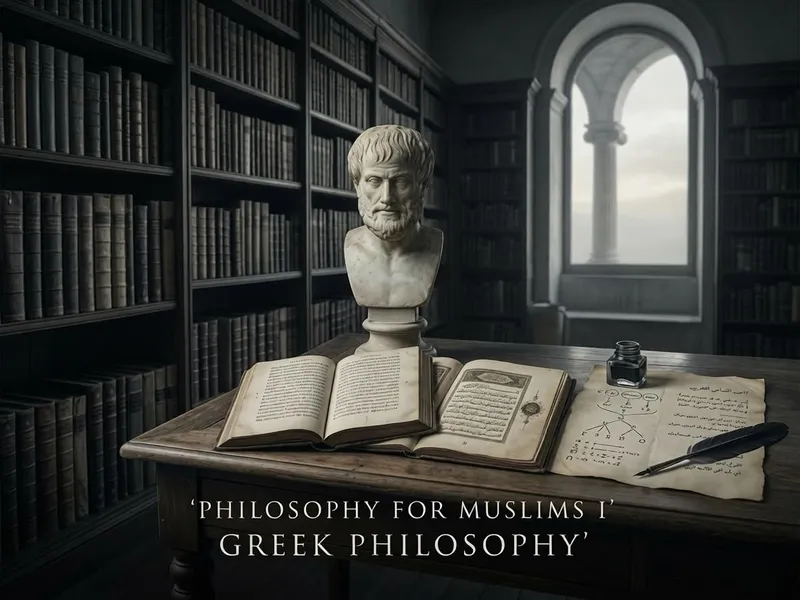
Philosophy for Muslims I: Greek Philosophy
Plato, Aristotle, Plotinus — taught through an Athari lens, with early Hanbali creedal texts. A 6-week live online seminar providing clear tools for truth, argument, reality, and theology.
Ustadh Reece Byfield
BA Philosophy (First Class), King's College London. MPhil Theology, Religion and Philosophy of Religion, University of Cambridge.
Syllabus
Week 1 Introduction — Why Greek Philosophy?
Why Greek philosophy entered Islamic civilisation and what philosophy claims to do. Setting the stage for the theological encounter.
Introduction — Why Greek Philosophy?
Why Greek philosophy entered Islamic civilisation and what philosophy claims to do. Setting the stage for the theological encounter.
- The historical transmission of Greek thought into the Islamic world
- What philosophy is and what it claims to achieve
- Why Muslims need to understand this tradition
Week 2 Plato — Forms, Knowledge & Virtue
The theory of Forms, Plato's account of knowledge and the soul, and where these ideas create pressure points for Islamic 'aqidah.
Plato — Forms, Knowledge & Virtue
The theory of Forms, Plato's account of knowledge and the soul, and where these ideas create pressure points for Islamic 'aqidah.
- The theory of Forms and its implications
- Knowledge as recollection — the soul's pre-existence
- 'Aqidah pressure points: where Platonic ideas conflict with Islamic theology
Week 3 Aristotle I — Categories & Causality
Aristotle's system of categories and his four causes. How these ideas shaped Islamic discussions of divine action and secondary causation.
Aristotle I — Categories & Causality
Aristotle's system of categories and his four causes. How these ideas shaped Islamic discussions of divine action and secondary causation.
- The ten categories and substance-accident distinction
- The four causes: material, formal, efficient, final
- Divine action and the question of secondary causes
Week 4 Aristotle II — Ethics & Purpose
Aristotle's virtue ethics and concept of human purpose (telos). Connections to the Islamic concept of fitra and moral knowledge.
Aristotle II — Ethics & Purpose
Aristotle's virtue ethics and concept of human purpose (telos). Connections to the Islamic concept of fitra and moral knowledge.
- Virtue ethics and the good life (eudaimonia)
- The concept of telos — purpose and final ends
- Fitrah and moral knowledge in light of Aristotelian thought
Week 5 Plotinus — The One & Emanation
Neoplatonism's most influential idea: emanation from the One. Why this matters for the Creator–creation distinction in Islamic theology.
Plotinus — The One & Emanation
Neoplatonism's most influential idea: emanation from the One. Why this matters for the Creator–creation distinction in Islamic theology.
- The One, Intellect, and Soul — Plotinus' hierarchy
- Emanation vs. creation ex nihilo
- The Creator–creation distinction and why it matters
Week 6 Reception Map — Falsafa, Kalam & Athari Boundaries
How Greek philosophy was received across the Islamic tradition: by the philosophers (falsafa), the theologians (kalam), and the Sufis (tasawwuf). Where Athari theology draws the line.
Reception Map — Falsafa, Kalam & Athari Boundaries
How Greek philosophy was received across the Islamic tradition: by the philosophers (falsafa), the theologians (kalam), and the Sufis (tasawwuf). Where Athari theology draws the line.
- Falsafa: al-Kindi, al-Farabi, Ibn Sina
- Kalam: Ash'ari and Maturidi engagement with philosophy
- Tasawwuf: Sufi absorption of Neoplatonic ideas
- Athari boundaries: what to take, what to leave
Course Overview
Clear tools for truth, argument, reality, and theology. A 6-week live seminar on Plato, Aristotle, and Plotinus, with an Athari-lensed analysis and early Hanbali creedal texts.